
Mullumbimby Civic Centre Battery Announcement
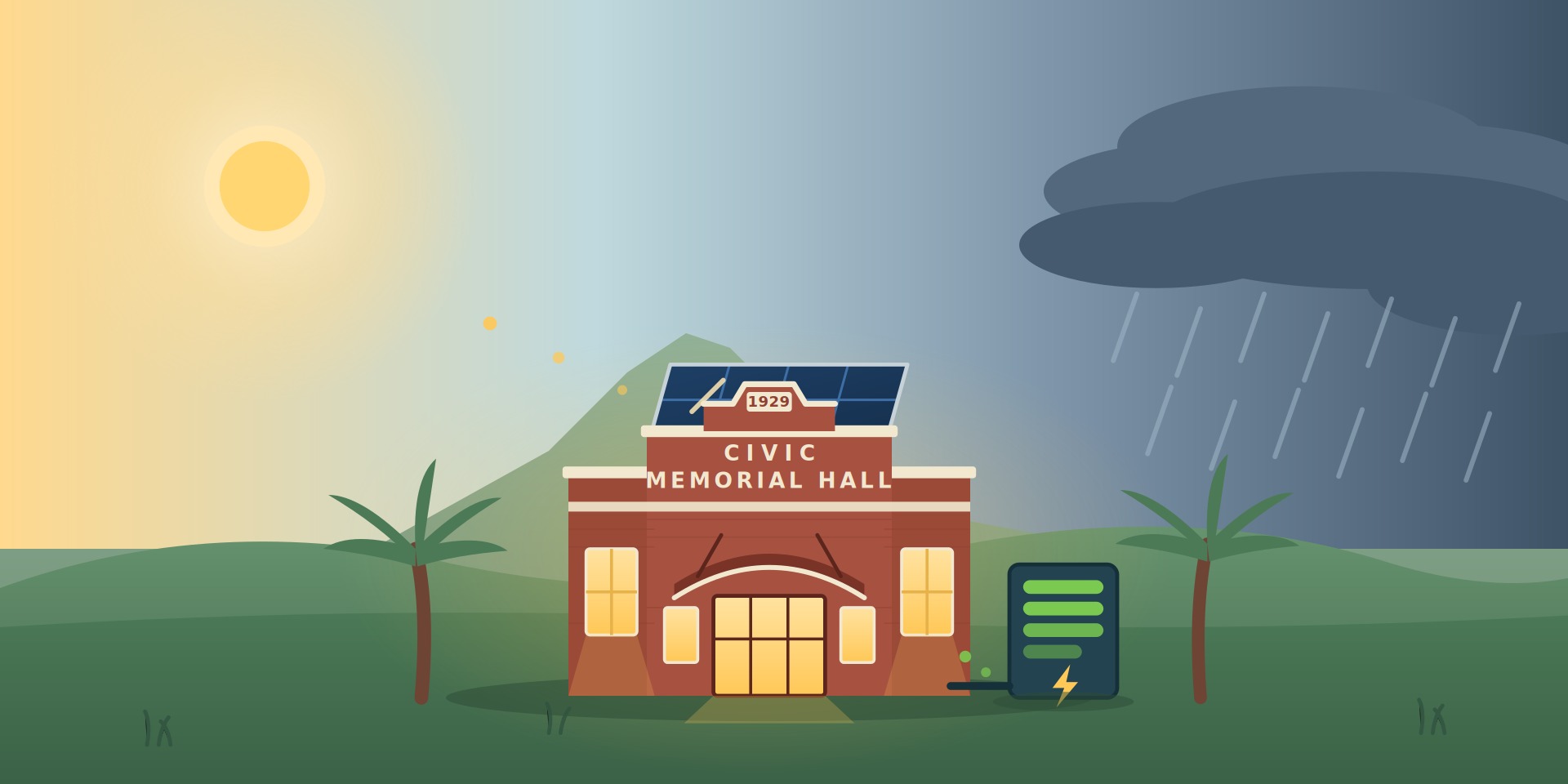
Mullumbimby Civic Centre Set to Trial Community Battery & Solar System
A community-led push for resilient, renewable power takes a major step forward Zero Emissions Byron (ZEB) is excited to share an update on a project we’ve been championing since early 2025: bringing solar and battery storage to Council-owned community facilities across the Shire.
How it started
In early 2025, ZEB Chair Anne Stuart and Jill Moonie of the Brunswick Residents Association (now a ZEB Board member) lobbied Byron Shire Council to embrace renewable energy on its community buildings and invest in battery storage. Their case was simple: given the Shire’s recent history of bushfires, floods and extended power outages, community resilience matters — and batteries paired with solar could help deliver it. By September 2025, Council had agreed to investigate whether solar and batteries could be installed on community facilities to provide power in an emergency. A Community Battery Working Group formed soon after, spending five months exploring possible operating models. The idea was twofold: a replicable model that puts batteries on Council-owned facilities with existing or potential solar — feeding energy back to the grid at night for a financial return — while also providing backup power when the grid goes down.
With the Working Group’s support, Council engaged renewable energy consultants Beam Consulting to assess which facilities could best support battery storage, what the community benefits would be, and what it would cost.
First site: Mullumbimby Civic Centre
The first system proposed is a 10kW solar PV + 24kWh battery energy storage system (BESS) for Mullumbimby Civic Centre. Beam Consulting’s assessment involved:
- Desktop analysis — checking network supply capacity and connection limits, gathering electricity interval data, and reviewing energy tariffs.
- Site inspection — assessing the switchboard’s location, condition and spare capacity, checking available space and compliance for battery and rooftop solar, and identifying locations for solar panels, the battery, converters, load-shedding control circuits and cable routes.
- Design output — preliminary system layouts and design drawings.
Three ways to run it
The consultants modelled three operating scenarios for the site:
- Load Following + Backup (0% reserved) — maximises grid offset and financial savings, but leaves no guaranteed battery reserve for outages.
- Backup Power Resilience (100% reserved) — maximises outage protection, but forgoes day-to-day financial and emissions benefits.
- Optimised (50% reserved) — a blend of both, balancing daily savings with guaranteed backup capacity.
Putting it to the test
To understand how the system would perform in a real emergency, outage simulations were run under two conditions:
- Typical sunshine: an average simulated outage delivered roughly 53 hours of backup power.
- Storm conditions (7% solar irradiance): an average simulated outage delivered roughly 22 hours, with the shortest simulated outage providing around 4 hours using only 20% load shedding — an area the assessment flagged as improvable with more aggressive load shedding.
These figures assume 80% of the site’s load is essential, managed through clear manual load-shedding procedures for staff during an outage.
Why Mullumbimby Civic Centre
The site is a well-established community hub for disaster response, already has air-conditioning (valuable for heat resilience), and has some consumption data available through its existing solar monitoring — making it a strong candidate to lead the way.
Funding update
An Expression of Interest was submitted under the NSW Community Building Partnership 2026 grant program specifically for Mullumbimby Civic Hall. The project was shortlisted, and a detailed application went to the NSW Community Building Partnership on 17 July 2026. This
state grant program supports local infrastructure projects that strengthen the wellbeing of NSW communities.
The funding outcome will be announced on 22 January 2027.
Zero Emissions Byron will keep the community updated as this project progresses. Stay tuned for further news on the funding outcome and next steps toward a more resilient, renewable-
powered Byron Shire.


